Credit card debt: what happens, and what you can actually do
Credit card debt is not a priority debt, and it is unsecured — the lender has no automatic right over your home. Here is the escalation process in order, what your rights are, and how this debt is treated in each UK debt solution.
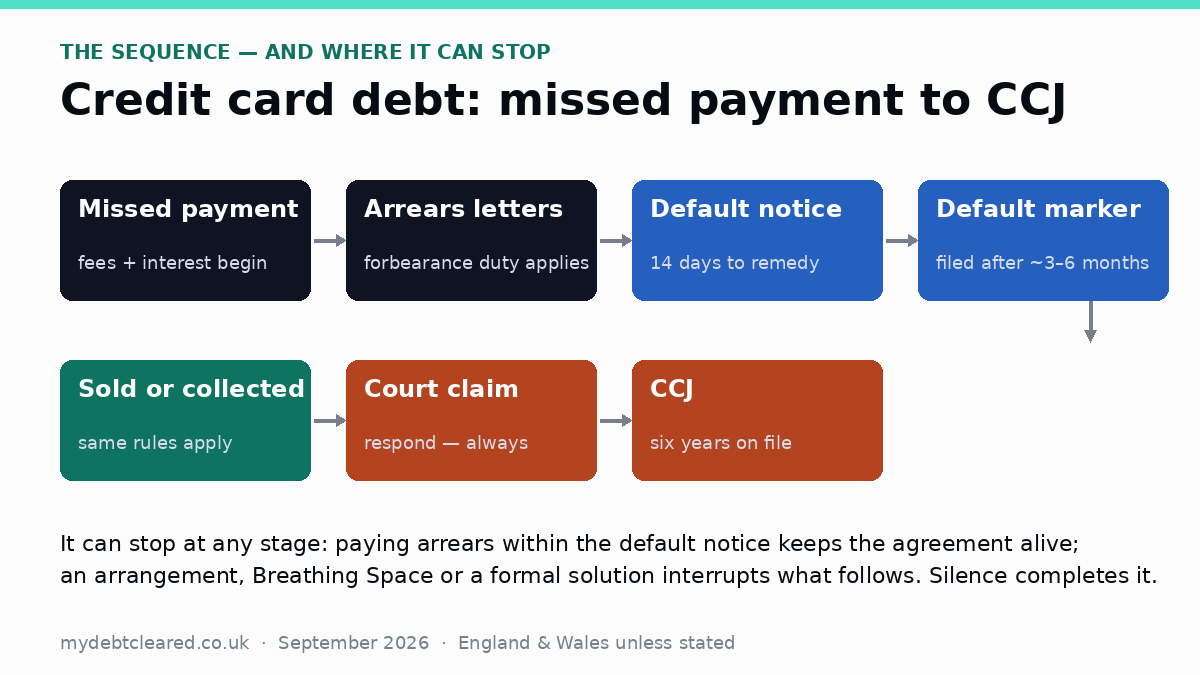
Every stage of card debt, covered properly
You never have to pay for debt advice. MoneyHelper (government-backed), StepChange, National Debtline and Citizens Advice all give free, confidential advice with no obligation. We would rather you got good advice somewhere than bad advice from anyone. Overdrafts sit alongside cards in most budgets — how to pay off an overdraft applies the same logic to the bank. The same default mechanics apply to loans — personal loan default covers the section 87 notice and what follows. At the solution stage, the most common confusion is whether a DRO and a DMP are the same thing — they are not, and the difference is write-off. A lump sum changes the whole calculation — full and final settlement can clear card debt for less than the balance.
Where this debt sits in the hierarchy
This debt is unsecured, so no lender has an automatic right over your home, and nobody goes to prison for it. That does not make it harmless — a default, a County Court Judgment and enforcement are all real — but it does mean rent, mortgage, council tax, energy and court fines come first if you have to choose.
What actually happens, in order
You miss a payment
A late fee is added and the missed payment is reported. One month is recoverable.
Two to three months
You receive a Notice of Sums in Arrears and then usually a default notice giving you at least 14 days to put things right.
Three to six months
A default is registered. It stays on your credit file for six years from that date, regardless of when you clear the balance.
Six months onwards
The account is closed and often sold to a debt purchaser. The balance usually stops growing at this point, which is one of the few pieces of good news in the process.
Later
A County Court Judgment may be sought. If one is obtained and unpaid, enforcement follows — an attachment of earnings, a charging order on a property, or enforcement agents.
What people are not usually told
Two things about credit cards specifically. First, minimum payments are designed to be survivable rather than to clear the balance — on a typical card, paying only the minimum on a £5,000 balance can take well over twenty years and cost more in interest than the original debt. Second, under FCA rules, firms must treat customers in financial difficulty fairly, which in practice means many will freeze interest and accept a reduced arrangement if you tell them you are struggling. Asking costs you nothing and is far more effective than going silent. If letters have started arriving, the sample letter centre has the freeze-interest and repayment-offer templates most card situations need. Buy-now-pay-later balances behave like card debt with their own wrinkles — the BNPL guide covers Klarna, Clearpay and the rest.
How this debt is treated in each solution
Every formal solution handles debts differently, and this one is no exception.
| IVA | DMP | DRO | Bankruptcy | |
|---|---|---|---|---|
| Formal insolvency | Yes | No | Yes | Yes |
| Where it applies | England, Wales and Northern Ireland | The whole of the UK | England and Wales (Northern Ireland has its own version with different thresholds) | England, Wales and Northern Ireland (Scotland calls it sequestration) |
| Typical duration | 60 months, or 72 with home equity | Until the debt is repaid — no fixed end | 12 months | Discharged in 12 months; payments up to 3 years |
| Monthly payments | Monthly, affordability-based | Monthly, flexible, changeable | No payments at all | Only if you have surplus income |
| Your home | Excluded; equity sets the term | Not affected | Not available to homeowners | May be sold |
| Credit file impact | 6 years from the start date | Defaults recorded, 6 years each | 6 years from the order date | 6 years from the order |
| Public register | Listed on the public Individual Insolvency Register, which anyone can search. Your address can be withheld only on evidenced safety grounds. | Nothing public. A DMP is a private arrangement. | Listed on the public Individual Insolvency Register. | Listed on the public Individual Insolvency Register, and in some cases advertised more widely. |
| Fees | Paid from your monthly payments | Free providers available | Free — no application fee | £680 application fee |
| Creditor protection | Legally binding on included creditors | None — entirely voluntary | Full protection, then write-off | Full protection, then discharge |
Arrears existing at the start date can usually be included in a formal solution. Ongoing liabilities — this year's council tax, current rent, current energy usage — cannot be, and must be budgeted for separately.
Not sure which of these applies to you?
Answer eight questions about your circumstances and see which routes are worth understanding, before you speak to anyone.
Common questions
Should I keep paying my credit card if I can't afford my rent?
No. Rent is a priority debt because the consequence of not paying is losing your home. A credit card is not. If you are choosing between them, the priority debt wins every time — and any adviser telling you otherwise is wrong. Pay your rent, contact the card issuer, and explain the position.
Will my card be closed if I ask for help?
Very likely, yes, and this is worth knowing before you call. Most issuers suspend the account when a reduced arrangement is agreed. That is not a reason to avoid the conversation — the account will close anyway if you simply stop paying, just with more damage on the way.
Related guides
We are a marketing introducer. We publish information and, if you ask us to, we pass your details to an FCA-authorised debt advice firm we work with so they can contact you. We do not give debt advice, we do not provide debt solutions, and we do not decide whether any solution is right for you. We are paid by the firms we introduce people to, never by you. Read exactly how we make money.