Individual Voluntary Arrangement: what it is, what it costs and who it suits
An individual voluntary arrangement lasts 60 months, or 72 with home equity. Here is what you pay, what happens to your home and credit file, and the risks — explained without the sales pitch.
You never have to pay for debt advice. MoneyHelper (government-backed), StepChange, National Debtline and Citizens Advice all give free, confidential advice with no obligation. We would rather you got good advice somewhere than bad advice from anyone. The IVA calculator shows what your payments would add up to over the term, and writing off debt puts an IVA alongside every other route that genuinely does it. Birmingham residents have a local guide to the advice route and support. Before speaking to any provider, it is worth understanding how IVA companies make money — the fees are legitimate, but the incentive shapes the advice. Live in Scotland? IVAs do not operate there — the Protected Trust Deed is the counterpart. An IVA can also end early — a lump-sum settlement variation completes it ahead of term if creditors accept. Weighing it against everything else first? The alternatives to an IVA are set out factually, unranked.
Checked against the 2025 IVA Protocol and current Insolvency Service guidance. Figures verified 2026-08-14. Primary source · every figure we use.
Every part of an IVA, covered properly
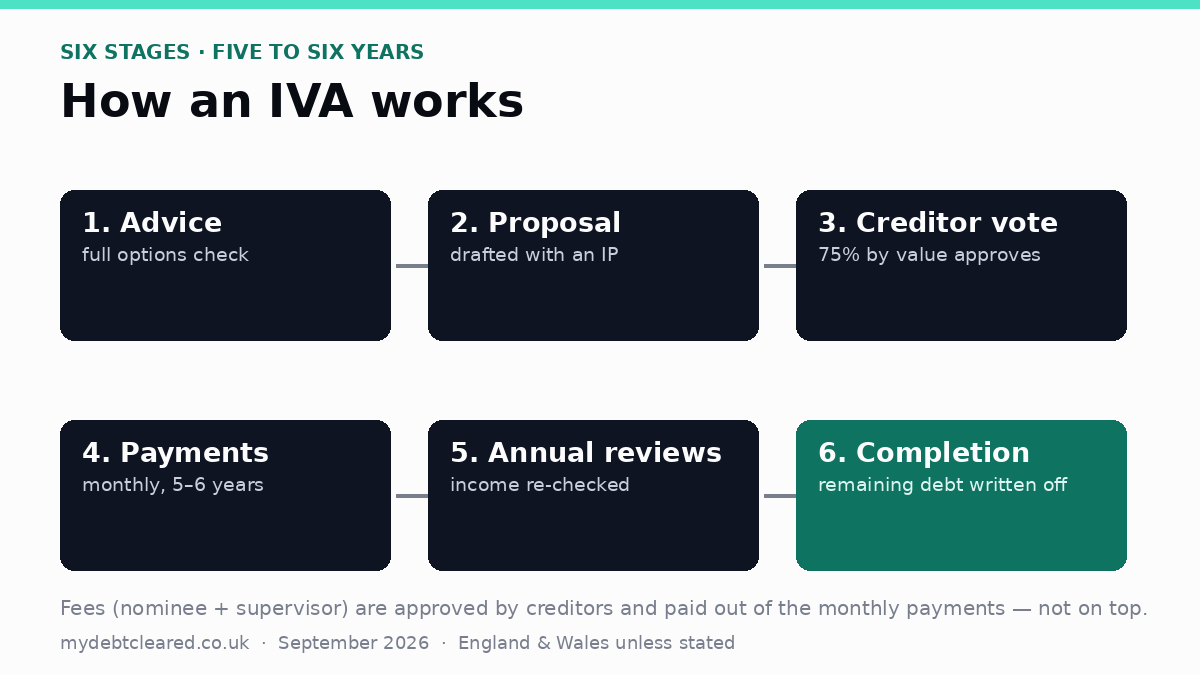
An IVA is a five-year legal process with rules for every situation it meets. Each of these covers one of them in full:
How it works
A single monthly payment based on what you can afford after essential living costs. Proposed at 60 months, or 72 months where you hold a beneficial interest in a family home of £10,000 or more. Under the 2025 IVA Protocol the longer term is paid in lieu of that equity — the home itself is excluded from the arrangement.
Who it is for
People with multiple unsecured debts, a reliable monthly surplus, and often assets or a home they want to protect. The 2025 IVA Protocol indicates typical suitability includes several debts totalling around £7,000 or more, and not being eligible for a DRO.
What it costs
Nominee and supervisor fees are payable, but they come out of your monthly payments rather than being charged on top. Fewer pounds reach your creditors as a result.
What happens to your home
Your family home is excluded from a protocol IVA. Under the 2025 IVA Protocol there is no requirement to realise your interest in it, and no year-five revaluation. Your beneficial interest is assessed once at the start — 85% of the property value less secured borrowing — and if it comes to £10,000 or more, the term is proposed at 72 months rather than 60, in lieu of that equity.
What it does to your credit file
Recorded for 6 years from the start date. Because an IVA usually runs 5 years, it stays on your file for about a year after it finishes. Listed on the public Individual Insolvency Register, which anyone can search. Your address can be withheld only on evidenced safety grounds.
Protection from creditors
Once approved, creditors bound by the arrangement cannot pursue you, add further interest or charges, or take court action for the included debts.
The risks you need to weigh
- If you stop being able to pay, the IVA can fail. Interest and charges can be added back on and creditors may petition for your bankruptcy.
- Fees reduce what your creditors receive, so more of your payment goes to costs than in a free Debt Management Plan.
- It is a public record for the duration.
- Holding £10,000 or more of beneficial interest in a family home means a 72-month term rather than 60.
- Some debts cannot be included — student loans, court fines, child maintenance and secured debts among them.
How it compares
| IVA | DMP | DRO | Bankruptcy | |
|---|---|---|---|---|
| Formal insolvency | Yes | No | Yes | Yes |
| Where it applies | England, Wales and Northern Ireland | The whole of the UK | England and Wales (Northern Ireland has its own version with different thresholds) | England, Wales and Northern Ireland (Scotland calls it sequestration) |
| Typical duration | 60 months, or 72 with home equity | Until the debt is repaid — no fixed end | 12 months | Discharged in 12 months; payments up to 3 years |
| Monthly payments | Monthly, affordability-based | Monthly, flexible, changeable | No payments at all | Only if you have surplus income |
| Your home | Excluded; equity sets the term | Not affected | Not available to homeowners | May be sold |
| Credit file impact | 6 years from the start date | Defaults recorded, 6 years each | 6 years from the order date | 6 years from the order |
| Public register | Listed on the public Individual Insolvency Register, which anyone can search. Your address can be withheld only on evidenced safety grounds. | Nothing public. A DMP is a private arrangement. | Listed on the public Individual Insolvency Register. | Listed on the public Individual Insolvency Register, and in some cases advertised more widely. |
| Fees | Paid from your monthly payments | Free providers available | Free — no application fee | £680 application fee |
| Creditor protection | Legally binding on included creditors | None — entirely voluntary | Full protection, then write-off | Full protection, then discharge |
Not sure which of these applies to you?
Answer eight questions about your circumstances and see which routes are worth understanding, before you speak to anyone.
Common questions
Can my creditors refuse an IVA?
Yes. An IVA needs the approval of creditors holding 75% by value of those who actually vote. If enough of them vote against, the proposal fails. In practice large creditors and their agents vote regularly, and some have their own criteria — for instance a minimum expected return. A good insolvency practitioner will tell you honestly whether your proposal is likely to be accepted before you commit to anything.
What happens if I miss a payment?
One missed payment is not usually fatal. Most IVAs allow some flexibility, and your supervisor can propose a variation to reduce payments or grant a short break if your circumstances change. What causes failure is repeated missed payments without contact. If you cannot pay, tell your supervisor immediately — the outcome is almost always better than going quiet.
Will my employer find out?
Usually not. There is no requirement to tell your employer, and an IVA is not something employers are notified about. However, it is on the public Individual Insolvency Register, some professions require disclosure under their own rules, and a few employment contracts contain clauses about insolvency. If you work in financial services, law, accountancy or as a company director, check your own terms first.
Can I include my council tax arrears?
Arrears that exist at the date the IVA starts can normally be included. Council tax for the current and future years cannot be — that is an ongoing liability you have to keep paying. This trips a lot of people up, so make sure your income and expenditure allows for the current year's bill as well as the IVA payment.
What happens to my home if I own one?
Under the 2025 IVA Protocol your family home is excluded from a protocol IVA. There is no requirement to realise your interest in it and no year-five revaluation. Your beneficial interest is worked out once at the start — 85% of the property value, minus your mortgage and any other secured borrowing. If your share comes to £10,000 or more, the arrangement is proposed at 72 months instead of 60, and that extra year is paid in lieu of the equity. If your share is under £10,000, the term stays at 60 months and the home is simply excluded.
Older guidance describing a remortgage attempt in year five reflects the 2021 Protocol and no longer applies to new protocol IVAs.
Related guides
We are a marketing introducer. We publish information and, if you ask us to, we pass your details to an FCA-authorised debt advice firm we work with so they can contact you. We do not give debt advice, we do not provide debt solutions, and we do not decide whether any solution is right for you. We are paid by the firms we introduce people to, never by you. Read exactly how we make money.