What happens if you default on a personal loan?
Missed payments become arrears; arrears become a default notice; a default becomes a six-year marker, a possible sale to a debt purchaser, and — if ignored — a court claim. Every stage has rules, and at every stage you still have options.
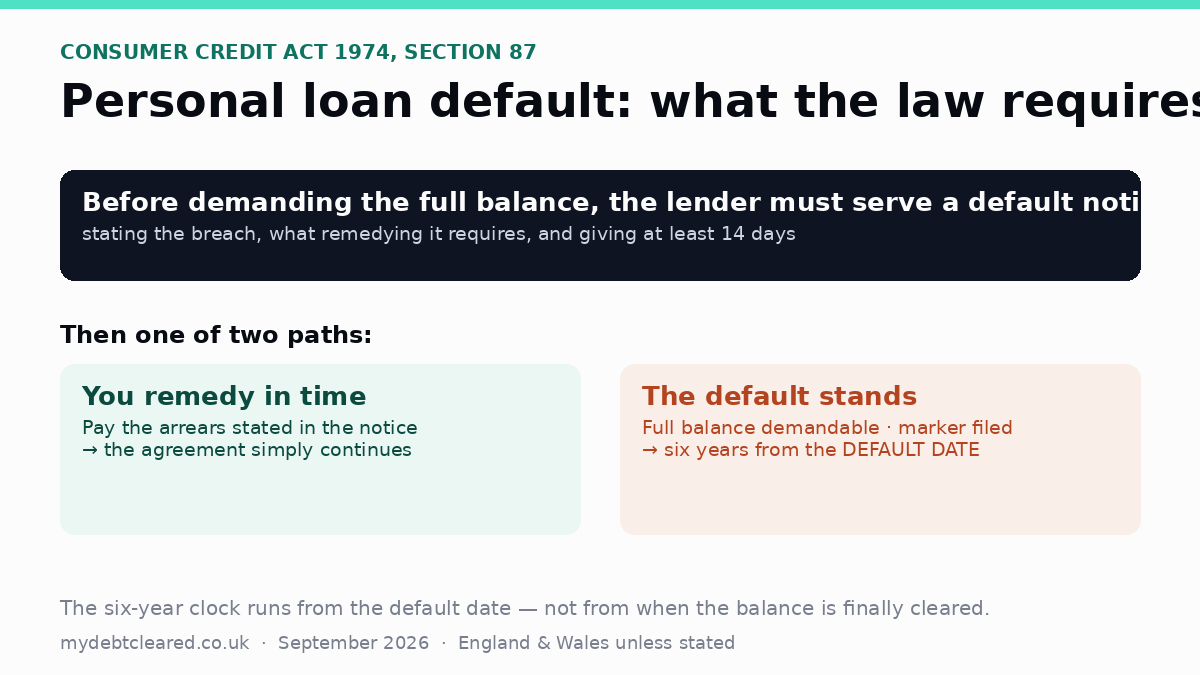
The sequence, stage by stage
Arrears and forbearance. FCA rules require lenders to treat customers in difficulty with forbearance and due consideration — which in practice means telling them early can produce a payment plan, a payment deferral or frozen interest, and saying nothing produces letters. The default notice. The section 87 notice must state what is owed, what remedying it requires and the deadline; pay the arrears within it and the agreement continues. Registration. Once recorded, the default marker is the single biggest credit-file event short of insolvency — and its date matters enormously, because the six-year clock runs from the default, not from when the balance is finally cleared. Sale or collection. A sold debt is still governed by the original agreement; the debt collectors guide covers what purchasers can and cannot do. Court. A claim can end in a county court judgment — but only after a claim form you can respond to, and often only when every earlier stage was ignored.
Will the lender actually take me to court?
Usually only after collection attempts fail, because litigation costs money and an unenforceable judgment helps nobody. The realistic risks scale with the balance and your visible ability to pay. What makes a claim more likely: silence, a balance worth suing over, and traceable income or assets. What makes it less likely: engagement, a token-payment arrangement through an adviser, or circumstances a court would respect anyway. If six years pass without payment or written acknowledgment, the limitation rules may bar recovery through the courts entirely — which is also why negotiating an old loan needs the statute-barred check first.
Your options at every stage
Before default: ask for forbearance in writing. After a default notice: pay the arrears within the deadline if you can; if you cannot, this is the moment for Breathing Space and advice, because the whole balance is about to become demandable. After registration: the damage to your file is done for six years, so decisions become purely about the debt — repay by arrangement, settle for less with a lump sum, or fold it into a formal solution if it sits among wider debts: a DRO (free, within its tests), an IVA, or bankruptcy. A free adviser will map which fits in one conversation.
You never have to pay for debt advice. MoneyHelper (government-backed), StepChange, National Debtline and Citizens Advice all give free, confidential advice with no obligation.
Joint loans and guarantors
Joint borrowers are each liable for the whole balance — a default marks both files, and a lender can pursue either. A guarantor loan in default moves to the guarantor with similar force: the guarantor’s own credit file and finances are on the line, and the same advice routes apply to them.