Bailiffs and enforcement agents: your rights and what happens
Everything a bailiff can do is written down, staged and fee-capped — and most of what people fear is the part the rules do not actually allow.
The three stages, and the fee at each
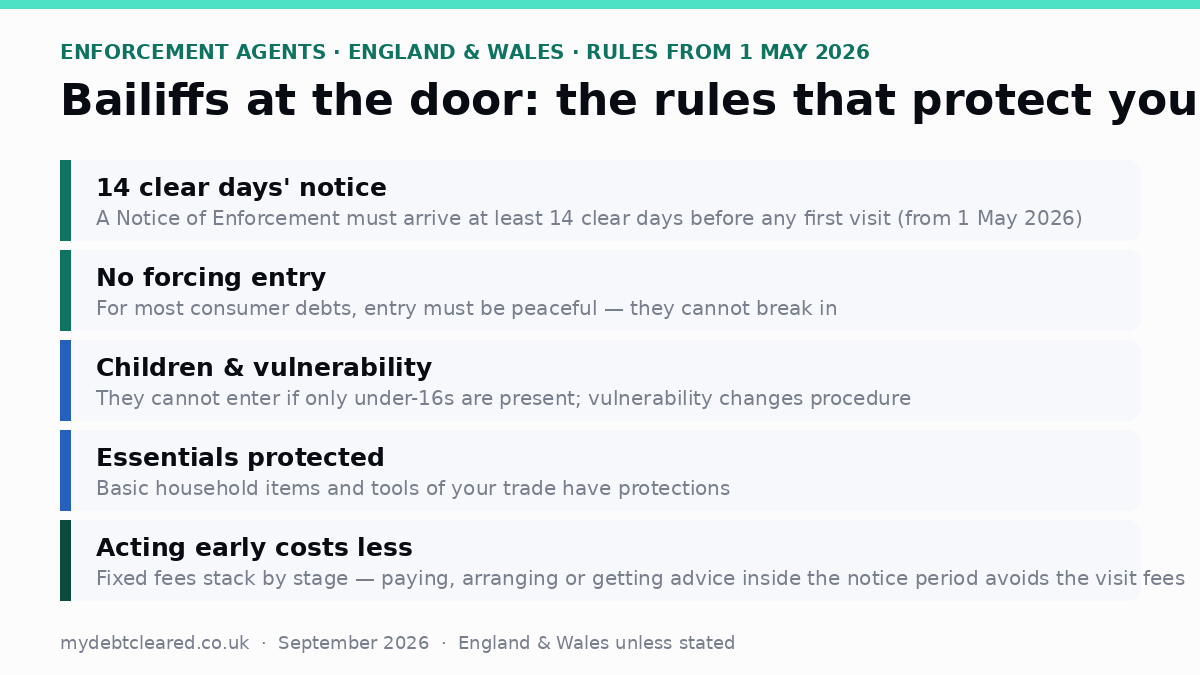
Compliance — the case reaches the agent, the notice of enforcement is sent, and £79 is added; nothing else may happen for 14 clear days. Enforcement — a visit adds £247, plus 7.5% of the debt above £1,900. Sale — removing and selling goods adds a further fixed fee. The arithmetic is the strategy: acting during the notice window, ideally with the creditor directly, is hundreds of pounds cheaper than acting at the door. A collector is not a bailiff — the debt collectors guide covers the difference in powers.
Can bailiffs enter your home?
For ordinary debts — council tax, CCJs, parking — no forced entry on a first visit: they enter through a door opened by someone 16 or over, peacefully. They must leave if only under-16s are present, may only visit 6am–9pm without a court order, and cannot climb through windows. Forced entry exists in narrow cases — magistrates’ fines, and to inspect or remove goods already under a controlled goods agreement — which is why signing one changes your position more than opening the door does.
What can bailiffs take?
Luxury and non-essential goods they can see or reach lawfully — and vehicles, which can be clamped or removed from your drive, workplace or a public road even with nobody home. They cannot take essential household items (cooker, fridge, washing machine, beds, essential clothing), tools of your trade up to a value limit, or goods that belong to someone else — though proving third-party ownership falls on the owner, in writing.
How enforcement is stopped
Payment or an arrangement with the creditor can pull the case back at any stage. Vulnerability — serious illness, disability, recent bereavement, pregnancy — obliges agents to pause and refer. Breathing Space halts enforcement for 60 days. And the formal solutions stop enforcement of included debts entirely. If a visit is expected imminently, the bailiff-at-the-door guide is the minute-by-minute version.
Bailiffs by debt type
Council tax enforcement is the most common and has its own full guide. CCJ enforcement follows court action. Magistrates’ fines carry the strongest powers, including forced entry — arrears there are a genuine emergency and a free-advice situation immediately.
When agents break the rules
Fee irregularities, entry violations and vulnerability failures are complaint material — first to the enforcement firm, then to the creditor who instructed them (councils answer for their agents), and onward to the relevant ombudsman or trade association. Keep the paperwork; the fee schedule above is checkable line by line.